
Important Roofing AccessoriesThat You Need For Your Roof

A strong roof is important for a building. But what are the roofing accessories that you need to enhance the performance of your roof? The roof of your building protects the structure from external factors such as rain, snow and the sun. A building is basically incomplete without a roof. So choosing the right roofing material is crucial for any building as the roof is subject to various climatic conditions. Additionally, Roofing Accessories increase the integrity and life of the Roof. Bansal Roofing Products Ltd. Well known as “BRPL” is a leading supplier of various Roofing sheets and Roofing Accessories and BRPL can help you with complete installation and enhancement of your roof with various roofing accessories mentioned below. List of Various Roofing Accessories: #1 – Flashing- Ridge, Gabble, Appron, Bottom, Corners etc. Flashing protects the rain water to enter to shed and it covers the roof sheet gaps which can not be covered by roof sheets. Roofing Accessories are ornaments of any building. If proper design and size of accessories are not selected then the roof will leak and the purpose will not be solved. One can choose the different (Contrast) colour of roofing accessories to increase the asthetic value of the shed. At Bansal we guide customers how to choose flashing so that the roof becomes leak proof and enhances the beauty of the shed. Also Read: How To Select Roofing Sheet #2 – Gutters (Water Channel): A gutter is a trough fixed under the edge of a roof to provide a channel for rainwater to be carried away. Gutters prove an essential part of a roof during rainy seasons as they help collect any excess water and dispose of it away safely. This prevents any unwanted water-logging and protects the area around the structure from water damage. We can provide seamless and customised gutters according to the application and requirement. #3 – Butyl Tape: Water can find its way inside the structure from roof overlaps if they are unattended. Applying butyl tape between the overlap of two roofing sections ensures watertight sealing and prevents any water from creeping in. Also Read: What is a Steel Building – Advantages and Applications #4 – Foam Filler / Silicone Sealant: It is necessary to ensure complete sealing of the roof, especially in rainy areas to prevent leakage in the long run. So silicon sealants are applied in gaps and on screws to keep the roof from leaking. At Bansal Roofing we’re committed to quality and ensure to provide only the best roofing accessories that will increase the performance of your roof in all kinds of weather conditions. We also take care of complete roofing sheet manufacturing to supply and installation of all kinds of roofing sheets and accessories.
Types of Perforated Sheetsand Its Benefits

The Perforated Sheet, also recognized as Perforated Metal, is a screen or sheet consisting of several holes that are either man-made or machine-made. The stamping or punching techniques make these holes on the metal sheet and the material used to design the sheet can differ depending on its applications and specifications. Perforated sheets are made of various materials, including stainless steel, aluminum and copper, and, depending on the specifications, perforations are carried out in various dimensions and shapes. These sheets are made in various types, such as round, square and other decorative shapes, depending on the function and specifications. For over a century or more, perforated plates or screens have been used to create a pattern of holes, shapes, or slots. Perforating is the method of manually pressing or stamping on the sheet to shape the given pattern of holes and slots. These metals have been used in fields ranging across industries, including construction, architecture, chemicals, food, and automotive. Design And Patterns: Perforated sheet requirements generally include the sheet thickness and duration, the patterns, the shape of the holes and the pitch that defines the distance between the adjacent perforation and the holes in the next row, as well as the margins in the case of special borders. The manufacturers of perforated sheets design the sheet in sizes, and the size of the perforated sheet typically depends on the applications and specifications. The size can be adjusted by manufacturers depending on the place where it will be used and its applications, whether it is needed for domestic or home requirements. Materials Used in Perforated Sheets: There are various materials used to design a perforated sheet, and the price of the perforated sheet varies according to the form, size and material used to design it. Stainless steel is the most common material used in the construction of the Perforated Sheet and the second choice is aluminum. Changes in size from application to application and decorative objects are primarily made of stainless steel or a blend of different materials. Usually, domestic perforated plates are made from plastic materials. Here are some types of Perforated sheets and their uses. Also Read: How to Choose Roofing Material? Types of Perforated Sheets and It’s Uses: #1 – Mild Steel Perforated Sheet: For ventilation grilles, drying grids, infill plates, Mild Steel Perforated Sheets can be used. Perforated sheets of mild steel and perforated sheets of carbon steel, where perforations permit the passage of light, air, liquid and sound through its openings. It is very resistant and lightweight to corrosion, has a mill, not a glossy finish, and is available in a variety of sizes and shapes with punches. #2 – Aluminum Perforated Sheets: As ordinary steel does, aluminium perforated sheets do not readily corrode, rust or stain with water. However in low -oxygen, high -salinity, or poor air circulation conditions, it is not completely stain-proof. They are strongly alloyed and have a resistance to corrosion that helps produce signboards, filtering plates, screens for cement slurry and numerous others. Also Read: The Difference Between Prefabricated and Pre-Engineered Steel #3 – Alloy Steel Perforated Sheet: The most flexible of all alloy steel sheets are Alloy Steel Perforated Sheets. Appropriate high-performance steel is needed for cost, quality, miniaturization, durability, safety, environmental protection and high-end general performance demands. This is used in the development of fencing screens, drying baskets for machines. A large combination of mechanical and electrical properties is offered by Bansal’s Perforated Sheets, combined with outstanding formability special to copper alloys. In most industrial sectors, its antimagnetic properties, good wear resistance and most corrosive conditions, as well as its good cryogenic temperature resistance, favour its use. Call Bansal’s Roofing LTD at +91-9925050913 & +91-265-2581082 or drop your inquiry @ inquiry@bansalroofing.com for more information and free consultation.
How To Select Roofing Sheet

Choosing roofing sheets are typical and you must take advice from an expert. Traditional roofing material like Asbestoses Cement sheets, Circular profile iron sheets, Mangalore Tiles are now old fashion and do not suit the existing requirement of users. In the past decade, the Indian roofing industry has undergone a tremendous change. And there are two factors that can be attributed to the primary changes in the roofing sheets market. First the development of industrial applications in the Indian market. Secondly, customers are disappointed with the existing choices available and are searching for more value from their investment in sheet roofing. Following are some of the parameter to choose Roofing Sheet: Parameters Roofing Sheets Long Life Metal roof, Aluminum Roof, S.S. Roof Asthetic Colour Coated Metal Roof, Polycarbonate, Tile Profile Heat/Thermal Insulation Insulated roof (PUF, EPS, and Rock Wool etc.) Fire Retardent Metal Roof High Impact Strength Metal Roof Light Weight Aluminum Roofing, Plastic Roofing Chemical Resistance S.S. Roofing, FRP, UPVC, Aluminum Roofing Coastal Area S.S. Roofing, Aluminum Roofing, Plastic Rain Water Noise Protection Insulated Roofing Hailstorm Area Metal Roofing Sunlight Requirement FRP, Polycarbonate Virtually Maintenance Free Metal Roofing Scrap Value Or Resale Value Metal Roofing, S.S. Roofing, Aluminum Roofing Here’s a short overview of the most common styles of roofing sheets and their key application areas. Different Types of Roofing Sheets: Your building is just as strong as the materials it contains. Ultimately, the quality of protection your roof receives depends on the smart combination of different materials that work together to provide optimum efficiency. With their own collection of pros and cons, different styles of roof sheets come bundled. If perfectly mounted, they can greatly increase the lifespan of any roof type. Metal Roof Sheets: Metal roof sheets are extremely resistant to all weather conditions and are exceptionally robust and very hard to crack. As these roofing sheets are also lightweight, this strength does not come at a cost. Metal roof sheets are a great choice, whether for use on top of a garden building or to adorn your garage and protect your pride and joy. Metal roof sheets, able to withstand high temperatures, are an economical solution. These are available in designs and colours to suit any property and will let in light without the added weight of glass windows when paired with roof light panels. Different profiles are available depend upon requirement i.e. Wave Profile, Trapezoidal Profile (Mostly for roofing), Pencil profile (mostly suitable for wall cladding). Available in different Thickness ranging from 0.16 mm to 1.5 mm. It is most commonly roofing sheet. Some of the varieties of metal sheets are Pre painted Galvanized sheet, Galvalume sheets, PPGI , Colour coated sheets etc. Also Read: How To Install Roofing Sheets Plastic Roof Sheets: Plastic sheets are available in a variety of substrates like PVC, UPVC, FRP, Polycarbonate etc.These sheets are opaque and transparent. Opaque sheets are used in corrosive areas like chemical factories, Salt making units or areas near coastal areas etc. Polycarbonates sheets are mostly used for stadiums, shopping Malls, Complexes and Green Houses. If you’re constructing a building that falls into all of these categories, then the best option for you is plastic. If you plan to exert minimal weight on the rooftop, lightweight plastic designs are best. Something just to improve overall longevity, stronger plastics should be considered; it is worth noting that this would also drive up the cost. Plus, for overall strength, plastic sheet roofs cannot be comparable with polycarbonate or metal roofing sheets. Polycarbonate roof sheets provide unrivalled efficiency, whether used to erect a livestock park, aviary, garage, driveway or something else entirely. These are made with high-impact polypropylene resin and are engineered to be both light and durable as well as simple to mount. What separates polycarbonate from other products is that it is engineered to be pH neutral. This implies that these roofing sheets are extremely resistant to oils, water, solvents and even harsh chemicals, so they can certainly stand up to even the harshest conditions. Also Read: Fiber Reinforced Plastic Glass (FRP) – An Innovative Construction Material Aluminum Profile Sheets for Roofing: Aluminum sheets are being used widely nowadays as a substitute of metal sheets being light in weight, long lasting and good scrap value after use. It is also available in colour coated. Aluminum sheets are long lasting. Stainless Steel Roofing Sheet: Highly corrosive areas are being recommended by experts to use stainless steel sheets. Though initial costs are high, users will get good life over the span and would prove cheaper than other material. Also Read: 8 Benefits Of Using Colour Coated Roofing Sheets Insulated Roofing Sheets: Variety of Insulation sheets are available. Some of them are PUF insulated, Rockwool-Glass wool insulated, EPS insulated and many more Energy-efficient and durable Panels. Insulated sheets are Suitable for diverse applications. It can withstand wind velocity up to Maximum Level and heavy snowfall/rainfall. It can withstand extreme temperature from -50 degree Celsius to +50 degree Celsius.PUF having a thermal conductivity of 0.018 kCal prevents cross heat flow between room & outside ambiance. For more information to choose right roofing material please Contact Bansal Roofing Products Ltd. Free consultation and to evaluate your exact specifications and budget before setting out to purchase the most suitable roofing sheets BRPL team will help you.
5 Advantages of Metal Decking Sheets

Metal decking or steel decking has become one of the most preferred methods of construction in the recent years and there are various metal deck sheet suppliers that have emerged recently due to its newfound popularity in constructions of multi-storeyed buildings because of the flexibility that it provides combined with high strength. It also considerably speeds up the construction process. Due to such benefits, it has found usage in residential, commercial as well as industrial building constructions. Here are 5 advantages of metal decking that make it a desirable choice for construction. Advantages of Metal Decking: #1 – Less Weight: Slabs made with steel decking have high structural strength compared to traditional concrete slabs. This creates a high strength-to-weight ratio which allows for a massive weight reduction. This proves to be much more beneficial for multi-storeyed buildings as it brings down the entire weight of the construction significantly which can allow for lower foundation sizes. Metal decking makes the slabs lightweight and reduces the amount of work or support props required for slab casting. #2 – Cost Saving: Due to the reinforcement and strength given by the metal deck, in cases of composite slabs, the amount of concrete used in the slabs can be reduced by a large amount while maintaining the same strength. Moreover, the reinforcing steel can be reduced by 25% as the deck profile itself contributes largely to the tensile reinforcing property and thereby saves time and material required. This results in lower costs. Also Read: How To Install Roofing Sheets #3 – Easy Handling: Steel decking can be transported in pre-cut sizes according to the application on-site which can then be quickly laid out over the construction area. This greatly minimises work on-site and can help in faster construction. Moreover, the laying out of steel decking does not have to obstruct other processes being carried out on various parts of the construction site. In fact, the deck can be used as a working platform during construction and the masonry and other work can be carried out unhindered during and after the casting of the slab thereby reducing cost, time and labour. This allows for speedy and safe construction and requires less manpower to handle the activities. #4 – Easy Installation of Shuttering Material: Metal deck sheets act as composite members and as permanent shuttering resulting in savings of supply installation and installation of shuttering material. Additionally, provisions can be made on the steel decking or metal decking to fix cable trays and pipes which can then be easily laid out once the metal decking is in place. This significantly reduces costs incurred during the installation of these services on conventional slabs. Also Read: 10 Things To Consider Before Hiring An Industrial Roofing Contractor #5 – High Strength: Composite slabs made of concrete reinforced with metal decking can provide immense strength to the structure. The strength of the concrete combined with flexible reinforcement of the metal decking serves to provide an all-round stronger slab that can withstand a great amount of load over a long period of time. No major reinforcement is required unless the design parameters demand. The slab thickness can be reduced which can allow for lighter slabs while maintaining the same strength. This makes way for reduced foundation loads resulting in lesser material consumption and thus lowering the cost. Those were some of the benefits of metal decking which have made it such a popular method of construction these days. Bansal Roofing is a leading supplier of metal decking in Vadodara and Gujarat and the stock levels of steel or metal decking that have allowed us to deliver throughout the region in record times compared to any other conventional flooring systems.
How To Install Roofing Sheets
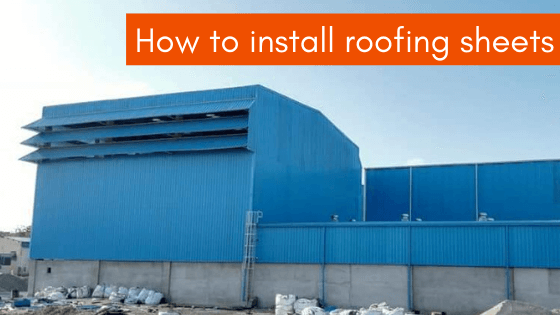
Roofing sheet installation, though sounds like a challenging task, can actually be done quite comfortably provided you have good guidance. Here, we will discuss the basic steps of how to install roofing sheets. Basic steps of how to install roofing sheets: Of course, roofing sheets come in a variety of sizes and shapes and there’s no one-size-fits-all design, so the selection of the size, shape and type of roofing sheet to suit your application is the first step that you should take before installation. #1 – Cutting The Roofing Sheet: While most of the roofing sheets are available in pre-cut sizes from the roofing sheet manufacturer, you don’t have to worry about this step as much. But in cases where you have to cut it yourself, it is important to do it carefully and be as precise as possible. All cutting must be done on the ground because if any such process is carried out on top of the structure during installation it will cause debris to accumulate in joints and corners which can degrade the life of the roofing sheet in the long run. Metal sheets should be cut while resting face down and on padded supports to prevent any damage to the roofing sheet. First, mark the layout using a marker. Only use appropriate tools for cutting like a circular saw or angle grinder. Try to keep the heat produced during the process to a minimum because this can cause damage to colour coated roofing sheets. #2 – Laying The Sheets: One of the trickiest parts in the process is laying the sheets properly so this must be done carefully. Make sure the sheets are perfectly aligned when laying them down or you might have to repeat the process all over again. It is a good idea not to secure the first few sheets as you’re laying them down because it will give you some room for adjustment and making corrections for alignment. Once the sheets are positioned correctly you may proceed with securing them down with the remaining fixings. Always use appropriate roof fasteners. Also Read: Types of Steel Deck used in Green Building Construction #3 – Weatherproofing The Sheets: Use mastic tape and stitching screws to achieve weather-resistant joints. Try to achieve a minimum overlap of 250 mm between sheet to sheet. Use sheet to sheet stitching screws spaced 600 mm apart along the overlap between the sheets to strengthen the bond created by the lapping tape. These laps should be supported by purlins underneath. Fixing hardware used in this process must also be weatherproof or they may spread damage to the roofing sheets under harsh weather conditions. #4 – Protrusions: If your application calls for vents, skylights or plumbing pipes to cause roof protrusions, these must be flashed and adequate framing must be installed to support the sheet around that area. The roofing sheet manufacturer should be able to provide appropriate flashing kits as per the protrusions. Bansal Roofing is a leading roofing sheet manufacturer in Vadodara and Gujarat and can carry out end to end activities from manufacturing to installation of roofing sheets. For more guidance and assistance, get in touch with Bansal Roofing right now.
5 Benefits Of Pre-Engineered Buildings (PEBs)

There are a number of benefits of Pre Engineered buildings or PEBs due to their easy method of construction. Pre engineered buildings is a concept of building that involves pre-designed and prefabricated steel structures which can be tailored according to the requirement and assembled at site. Pre-engineered buildings have become a very popular method of constructions all over the world due to their flexibility and ease of construction. Pre engineered are built using prefabricated I-shaped members, also known as I-beams. These I-beams can be shaped according to the requirements and available space and can be assembled at site. This greatly reduces the time spent in construction. Due to such pre engineering there is less amount of engineering required during the actual construction of the building at site. Several Advantages of Pre-Engineered Buildings (PEBs): #1 – Durability: Pre Engineered Buildings are built of I-frames which are sturdy in nature and are designed to take heavy loads. Also recently developed technologies allow to run software simulations on the structure before it is assembled. Since load considerations are already taken into account before construction, this can greatly enhance the quality of the structure and also increases the efficiency of the entire frame. Such methods also increase the life of the structure. #2 – Low Maintenance: The quality of materials used in pre-engineered buildings is always taken into consideration before proceeding with the design and the usage of corrosion resistant steel protects the structure from environmental factors. One of the most important benefits of PEBs is that it reduces the maintenance required on the structure for longer periods of time. Also Read: 8 Benefits Of Using Colour Coated Roofing Sheets #3 – Ease Of Construction: Since most of the engineering of the structure is done in the factory during prefabrication of the structure, this reduces the efforts required during the actual construction at site which makes the construction process much easier. Prefabricated and customised beams can be transported to the site and assembled together using bolts and nuts which also makes the assembly process comfortable and reduces the requirement of manual labour. #4 – Time Savings: One of the common benefits of Pre engineered buildings is the savings in the time required to finish the complete construction of the project. Since suitable materials are chosen beforehand and the idea of the structure is already designed it takes considerably less time than conventional buildings. So any required facility can be erected quickly and can be brought quickly in functioning condition which reduces the losses incurred in the projects due to lead times. Also Read: Bansal’s Touchless Sanitizer Dispenser #5 – Cost Savings and Flexibility: Suitable material can be selected before construction and after running all the calculations only the required materials can be procured. This makes for efficient material usage and less wastage. So this method of construction is highly cost effective. Also with all the savings in the lead times and construction time, the return of investment can be gained much faster than conventional methods of construction. This saves a lot of cost during the entire project.Pre Engineered Buildings are built on Foundation bolt. In case of shifting a factory shed to another location one has to simply unlock the bolt and can transport it to another location. Such benefits of Pre engineered Buildings or PEBs make them the perfect choice for construction in the present times. Due to such reasons, Pre Engineered Buildings are quickly replacing known conventional methods of construction in today’s world. For more details about Pre-Engineered Structures, You can contact Bansal Roofing Private Limited or Call us @ +91-9925050913.