
Table of Contents
- Introduction
- High-Rise Construction Challenges
- 3rd Mobile Crane to the BRPL Fleet Upgrade
- Technical Impact on Lifting Operations
- Safety Improvements in Modern Construction
- Operational Efficiency Gains
- Integration in Roofing & Steel Projects
- Industry Impact
- Feature Snippet Section
- Comparison Table
- FAQ Section
Introduction
The 3rd Mobile Crane to the BRPL fleet marks a major operational upgrade in high-rise construction and heavy lifting capability. As infrastructure projects become more complex and vertically demanding, lifting systems are no longer optional support equipment—they are core execution assets.
This addition strengthens BRPL’s ability to handle steel structures, roofing assemblies, and heavy construction materials with improved speed and precision. In modern construction environments, where deadlines are strict and safety requirements are higher than ever, this enhancement plays a critical role in improving project delivery outcomes.
For roofing and structural engineering companies such as Bansal Roofing, such advancements directly improve installation efficiency and reduce execution delays at height.
High-Rise Construction Challenges
High-rise construction involves continuous vertical movement of heavy materials. Steel beams, reinforcement cages, prefabricated roofing systems, and mechanical components must be lifted repeatedly to different elevations. This creates logistical pressure, especially when lifting equipment is limited.
Earlier systems often faced bottlenecks due to single-crane dependency. This resulted in delays, idle labor time, and increased coordination complexity. As building heights increase, these challenges multiply.
The 3rd Mobile Crane to the BRPL fleet directly addresses these constraints by increasing lifting availability and enabling parallel execution of tasks across multiple zones.
3rd Mobile Crane to the BRPL Fleet Upgrade
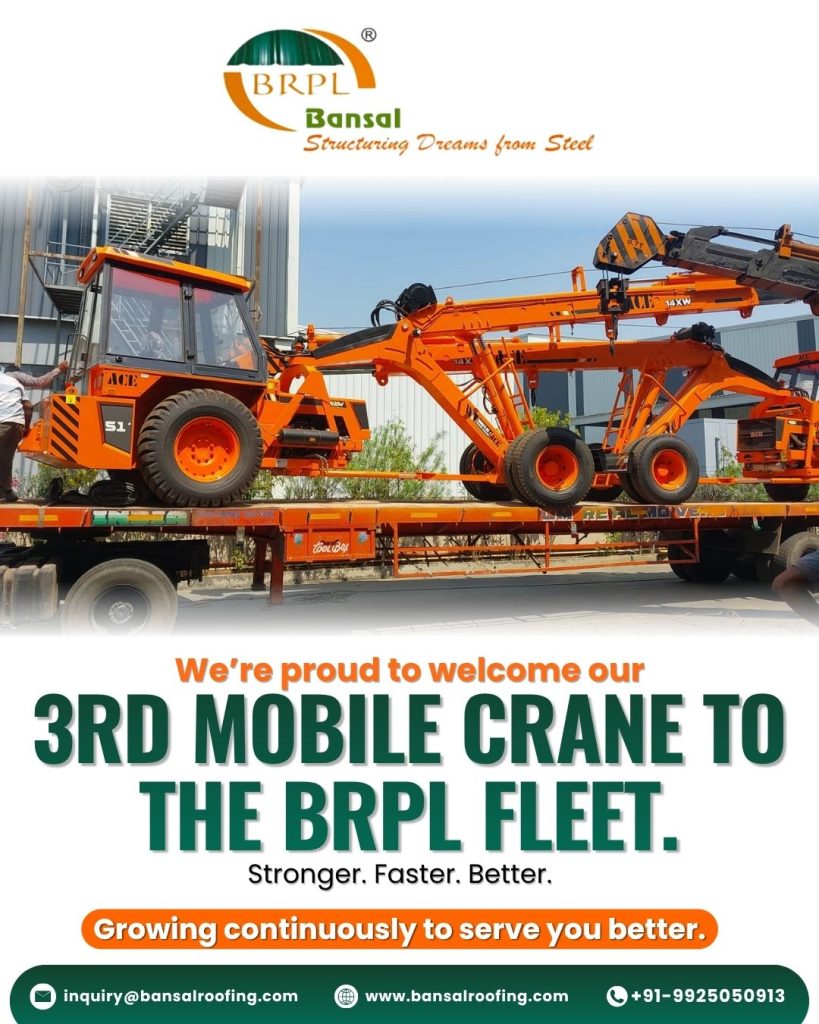
The introduction of the 3rd Mobile Crane to the BRPL fleet significantly increases operational flexibility. Instead of sequential lifting operations, multiple lifting activities can now take place simultaneously.
This upgrade also improves project redundancy. Even if one crane is undergoing maintenance or assigned to another site, operations can continue without interruption. This ensures better continuity in high-rise construction schedules.
The mobility factor further strengthens its advantage, allowing quick repositioning across sites without long setup delays.
Technical Impact on Lifting Operations
From a technical standpoint, mobile cranes provide controlled lifting capacity with hydraulic precision. The addition of the third crane enhances load distribution across projects, reducing pressure on individual machines.
This results in smoother handling of heavy steel structures and roofing components. Precision placement at height becomes more reliable, reducing installation errors and rework.
The system also improves adaptability in congested urban environments where fixed crane setups are not always feasible.
Safety Improvements in Modern Construction
Safety is one of the most critical aspects of high-rise lifting operations. The 3rd Mobile Crane to the BRPL fleet reduces dependency on manual lifting methods, which are more prone to accidents and instability.
Mechanized lifting ensures controlled movement of heavy loads, minimizing human exposure to high-risk zones. This aligns with global construction safety standards and reduces overall site hazards.
International Labour Organization Safety Standards
Operational Efficiency Gains
The operational impact of the 3rd Mobile Crane on the BRPL fleet is significant. Project timelines improve due to parallel lifting operations, while labor utilization becomes more efficient.
Material handling becomes smoother as multiple cranes can operate in different zones simultaneously. This reduces congestion at ground level and prevents workflow interruptions.
Overall productivity increases due to reduced waiting time and improved resource allocation.
Integration in Roofing & Steel Projects
In roofing and structural projects, lifting accuracy is essential. Steel trusses, roofing sheets, and prefabricated assemblies require precise placement at height.
The 3rd Mobile Crane to the BRPL fleet ensures smoother execution of such tasks by providing consistent lifting availability and controlled positioning.
This is especially valuable for industrial roofing projects where installation speed and alignment accuracy directly affect project cost and quality.
Industry Impact
The expansion of BRPL’s lifting capacity reflects a broader trend in the construction industry toward mechanization and scalability.
As urban infrastructure grows vertically, companies with higher lifting capacity gain a competitive advantage. Mobile cranes are becoming essential assets for high-rise construction execution rather than optional equipment.
📌 Feature Snippet (Google Answer Box Ready)
What is the 3rd Mobile Crane to the BRPL fleet?
The 3rd Mobile Crane to the BRPL fleet is an additional heavy-lifting machine that enhances construction capacity, improves high-rise lifting efficiency, and enables faster, safer, and more flexible material handling across infrastructure projects.
Why Choose Bansal Roofing?
Choosing the right roofing and structural solutions partner is a critical decision in any construction project, especially when dealing with high-rise buildings, industrial sheds, warehouses, and large-scale infrastructure works. 3rd Mobile Crane to the BRPL fleet. The performance of a structure is not only defined by its design but also by the quality of materials, execution capability, and long-term reliability of the roofing system used. In this context, Bansal Roofing has established itself as a dependable name in the Indian construction ecosystem by consistently delivering engineered roofing and structural solutions that align with modern industrial demands.
Bansal Roofing is not just a product supplier; it operates as a complete solutions provider for roofing sheets, PEB structures, insulation systems, and installation support. This integrated approach reduces dependency on multiple vendors, which is often a major challenge in large construction projects. By consolidating services under one system, project timelines become more predictable, coordination improves, and execution risks are reduced.
One of the strongest advantages of choosing Bansal Roofing is its focus on engineering precision and project-specific customization. Every construction site has different load requirements, environmental conditions, and design constraints. Instead of offering one-size-fits-all solutions, the company provides tailored roofing and structural systems designed to match project specifications. This becomes especially important in industrial and high-rise environments where even minor deviations can lead to structural inefficiencies or long-term maintenance issues.
Another key factor is material quality and durability. Roofing systems are constantly exposed to environmental stress such as heat, rain, wind load, and chemical exposure in industrial zones. Bansal Roofing emphasizes the use of durable, corrosion-resistant, and weather-adaptive materials that improve structural lifespan and reduce maintenance frequency. This directly impacts long-term cost efficiency for developers and contractors.
Operational capability is also a major differentiator. Large infrastructure projects require not just materials but also reliable execution support. With strong project experience across industrial, commercial, and infrastructure segments, the company is able to handle complex installation requirements with better coordination and planning. This reduces downtime on-site and ensures smoother execution of roofing and structural installation phases.
In modern construction, speed of execution is as important as structural strength. Delays in roofing installation can directly affect the entire project timeline. Bansal Roofing supports faster execution through organized supply systems and structured project planning. This helps contractors maintain continuity in high-rise and industrial projects where multiple teams depend on the timely completion of roofing and structural frameworks.
Safety and compliance also play an essential role. Construction environments require adherence to strict safety protocols, especially during high-rise lifting and steel installation activities. Mechanized handling systems and structured installation processes reduce manual risks and improve overall site safety. This aligns with global construction safety practices and helps maintain controlled working environments.
Another important aspect is versatility. The company’s solutions are used across multiple sectors, including industrial sheds, warehouses, commercial complexes, and infrastructure developments. This adaptability ensures that clients from different industries can rely on a single partner for varied project requirements, reducing procurement complexity and improving consistency in quality standards.
The company’s project portfolio further reflects its execution capability across different industrial environments. Experience in handling large-scale installations strengthens its ability to manage future projects with better efficiency and reduced operational uncertainty. This kind of track record is particularly important in infrastructure development, where reliability is a key selection criterion.
In addition, the integration of modern equipment such as mobile cranes and advanced lifting systems improves execution efficiency in high-rise construction environments. These systems reduce manual dependency and improve precision in lifting heavy structural components like steel beams and roofing assemblies. This becomes especially relevant in projects where vertical construction speed is critical.
From a cost perspective, optimized execution and reduced maintenance requirements contribute to better lifecycle value. Instead of focusing only on initial installation cost, Bansal Roofing’s approach emphasizes long-term structural performance. This results in lower repair frequency and improved asset durability over time.
Overall, choosing Bansal Roofing is a decision aligned with reliability, engineering strength, and execution efficiency. The combination of quality materials, structured project execution, and industrial experience makes it a practical choice for developers and contractors working in demanding construction environments.
📊 Comparison Table
| Feature | Before 3rd Crane | After 3rd Mobile Crane |
|---|---|---|
| Lifting Capacity | Limited to 1–2 cranes | Expanded multi-crane operations |
| Project Speed | Slower due to waiting time | Faster parallel execution |
| Safety Level | Higher manual dependency | Reduced manual handling risk |
| Site Efficiency | Moderate workflow delays | Smooth continuous operations |
| Flexibility | Low repositioning options | High mobility and deployment |
❓ FAQ Section
What is the importance of the 3rd Mobile Crane to the BRPL fleet?
It improves lifting capacity, reduces project delays, and allows simultaneous execution of high-rise construction tasks.
How does it help in high-rise construction?
It enables safe and efficient lifting of steel structures, roofing systems, and heavy materials at different elevations.
Does it improve safety on construction sites?
Yes, mechanized lifting reduces manual handling risks and improves controlled load movement.
What industries benefit from this crane expansion?
Construction, roofing, steel fabrication, and infrastructure development industries benefit the most.
How does it improve project timelines?
By allowing multiple lifting operations to be performed simultaneously, reducing waiting time and workflow bottlenecks.
Conclusion
The 3rd Mobile Crane to the BRPL fleet represents a clear shift toward higher efficiency, improved safety, and scalable execution in modern construction. Its addition strengthens overall lifting capacity and removes common bottlenecks that typically slow down high-rise and industrial projects.
With enhanced mobility and availability, construction teams can now manage multiple lifting operations in parallel, reducing idle time and improving coordination across structural, roofing, and steel installation work. This directly translates into faster project completion without compromising precision or safety standards.
In practical terms, this upgrade supports more controlled handling of heavy materials at height, reduces dependence on manual lifting methods, and improves consistency in execution quality. For roofing and infrastructure-related operations, including companies like Bansal Roofing, such capabilities contribute to smoother project delivery and better site management.
Overall, the 3rd Mobile Crane to the BRPL fleet is not just an equipment addition—it is a functional upgrade that improves how high-rise construction is planned, executed, and completed in a competitive infrastructure environment.