
Table of Contents
- Introduction
- What Are Ground-Mounted Solar Structures?
- Why Ground-Mounted Solar Structures Matter in Solar Projects
- Key Components of Ground-Mounted Solar Structures
- Types of Ground-Mounted Solar Structures
- Applications of Ground-Mounted Solar Structures
- Important Design Factors Before Choosing a Structure
- Why Material Quality and Engineering Matter
- Why Choose Bansal Roofing for Ground-Mounted Solar Structures
- FAQs
- Conclusion
Introduction
Ground-mounted solar structures have become one of the most important parts of modern solar power infrastructure. When people think about solar projects, they often focus first on solar panels, inverters, generation capacity, and payback period. However, the structural system below the panels is equally critical because it is the foundation that supports long-term performance, safety, and return on investment. A well-designed solar structure is not just a frame that holds modules in place. It is the backbone of the entire installation.
In utility-scale projects, industrial solar plants, commercial open-land installations, and captive power projects, the structural design directly affects panel stability, wind resistance, alignment, maintenance access, drainage behavior, and overall lifespan of the system. Poor-quality support structures can lead to panel misalignment, corrosion, foundation failure, high maintenance costs, and reduced system reliability over time. On the other hand, robust ground-mounted solar structures help project owners create a solar plant that remains stable, efficient, and dependable for years.
As India continues to expand renewable energy capacity, solar developers, EPC companies, industrial businesses, and infrastructure planners are increasingly looking for solar mounting solutions that are durable, engineered, and suited to local site conditions. This is where the right structural partner matters. A reliable manufacturer can help ensure that the mounting system is designed not only for load-bearing performance but also for lifecycle durability, ease of installation, and project-specific customization.
What Are Ground-Mounted Solar Structures?
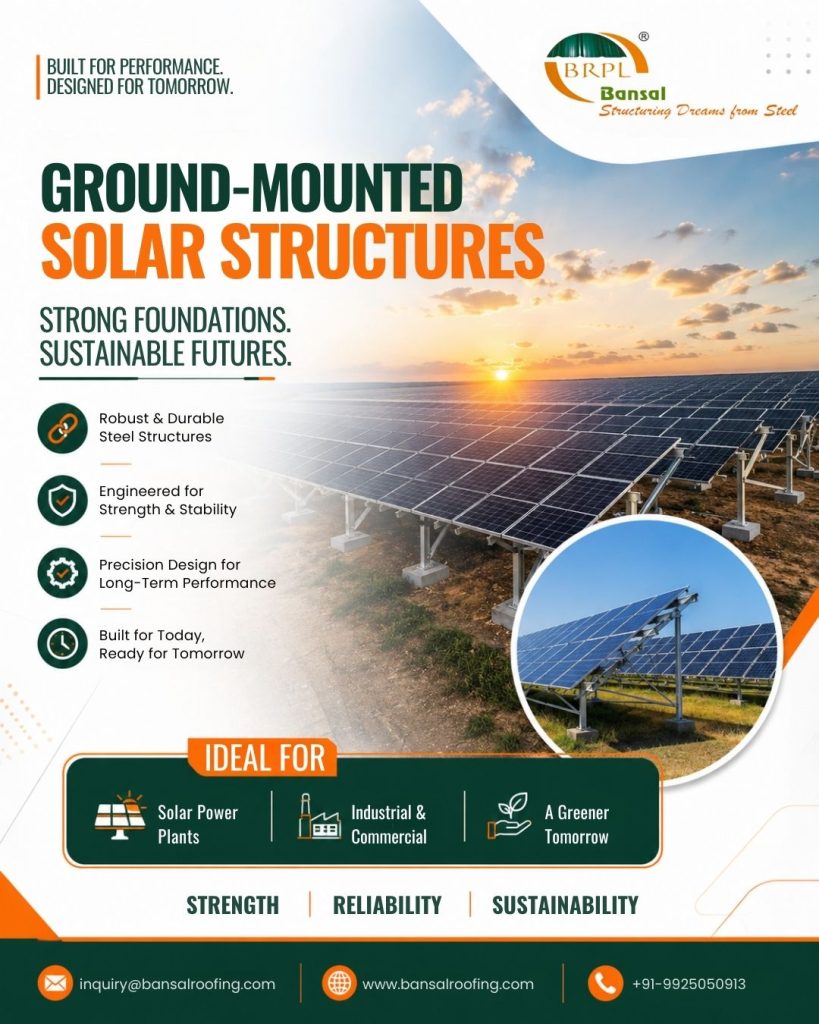
Ground-mounted solar structures are engineered steel support systems installed on land to hold solar panels at the required tilt angle and orientation. Unlike rooftop solar systems, these structures are not fixed to a building roof. Instead, they are installed directly on foundations prepared on the ground, which may include RCC pedestals, pile-driven systems, or other suitable base arrangements, depending on the site and soil conditions.
The purpose of a ground-mounted solar mounting system is simple in theory but demanding in practice. It must keep the solar modules securely positioned through years of exposure to wind, rain, heat, dust, and temperature fluctuations. It must maintain structural integrity under static and dynamic loads. It must also support practical project requirements such as proper row spacing, maintenance access, drainage management, and long-term corrosion protection.
In large solar parks and industrial solar plants, ground-mounted solar structures are often preferred because they provide greater flexibility in layout planning, module orientation, expansion, and land utilization. They can be designed for fixed-tilt systems and, depending on project requirements, can also be adapted for more specialized configurations. Their real value lies in combining structural strength with precision engineering so that the solar plant performs consistently over its full lifecycle.
Why Ground-Mounted Solar Structures Matter in Solar Projects
The performance of a solar plant depends on more than panel efficiency. The structural system underneath the modules plays a direct role in project reliability. If the structure is weak, poorly coated, or not engineered for the site, the entire solar installation becomes vulnerable. That is why Ground Mounted Solar Structures should be treated as a strategic asset rather than a minor steel component.
One of the biggest reasons these structures matter is stability. Solar modules remain exposed to environmental loads every day. Wind uplift, gust pressure, uneven terrain, soil settlement, and seasonal weather variation all place stress on the support system. If the structure does not have the required strength, the risk of misalignment, deformation, or even structural damage increases significantly.
Another major reason is durability. Solar projects are expected to operate for decades. Developers and industrial owners do not want frequent structural repairs, coating failures, rusting, or foundation issues. A high-quality structure reduces maintenance burden and protects the long-term economics of the project. This becomes especially important in hot regions, dusty industrial zones, coastal environments, and locations with heavy monsoon exposure.
There is also an efficiency angle. Properly engineered ground-mounted solar structures help maintain the intended tilt and orientation of modules. This supports energy generation consistency and simplifies cleaning and inspection. In practical terms, a strong structure protects not only the panel physically, but also the energy output and financial performance of the entire solar project.
For solar developers working in India, it is also useful to stay aligned with broader renewable energy and quality standards guidance published by the government and official institutions such as the Ministry of New and Renewable Energy and the Bureau of Indian Standards. You can refer to the Ministry of New and Renewable Energy (MNRE) for the broader renewable energy policy ecosystem in India and the Bureau of Indian Standards (BIS) for national standards relevant to construction and material quality. Ministry of New and Renewable Energy (MNRE) Bureau of Indian Standards (BIS)
Key Components of Ground-Mounted Solar Structures
Although the exact configuration may vary from project to project, most ground-mounted solar structures are built around a few essential structural elements. These include columns, rafters, purlins or rails, bracing systems, base plates or foundation connectors, fasteners, and corrosion-protected steel members. Every component has a specific role, and the quality of each part affects the overall performance of the installation.
The vertical support members carry the structural load and transfer it safely to the foundation. The horizontal members support the solar modules and maintain alignment. Bracing helps resist lateral forces and improves stiffness. Fasteners and connection details are equally important because poorly designed joints often become weak points in structural systems. In solar applications, even small issues in alignment or connection quality can create larger maintenance and reliability problems later.
Material selection is another important factor. Structural steel is commonly preferred for its strength, fabrication flexibility, and suitability for large-scale projects. However, steel performance depends heavily on grade, section design, coating quality, and fabrication precision. A properly engineered steel solar structure is expected to balance load capacity, corrosion resistance, and ease of installation.
This is why solar mounting systems should never be viewed as generic steel fabrication. Good ground-mounted solar structures are the result of structural design, project understanding, material quality control, and execution capability.
Types of Ground-Mounted Solar Structures
There is no one-size-fits-all solution in solar infrastructure. Different project sites require different structural approaches, and the right system depends on land conditions, project scale, environmental exposure, and operational goals. Still, most ground-mounted solar structures can be understood through a few common categories.
Fixed Tilt Ground-Mounted Solar Structures
Fixed tilt systems are among the most widely used solutions in utility and industrial solar projects. In these systems, the solar panels are installed at a pre-decided angle to optimize solar exposure for the location. Their popularity comes from a practical balance of cost, simplicity, structural reliability, and ease of maintenance.
For many industrial and commercial solar projects, fixed tilt Ground Mounted Solar Structures are preferred because they are straightforward to engineer, relatively easier to install, and well-suited for long-term operations. When designed correctly, they provide excellent structural performance with manageable maintenance requirements.
Elevated Ground-Mounted Solar Structures
Some projects require higher module clearance from the ground because of terrain, maintenance movement, cable management, vegetation control, or site-specific utility needs. In such cases, elevated structures may be used. These systems are designed to provide additional clearance while maintaining structural stability and proper load transfer.
Customized Industrial Ground-Mounted Solar Structures
Industrial and infrastructure projects often need custom-engineered solutions rather than standard module tables. Land conditions, plant layout, row spacing, project capacity, wind load, and maintenance access can vary significantly. This is why many serious solar developers prefer manufacturers who can design ground-mounted solar structures around the actual project instead of forcing the project into a standard design.
Applications of Ground Mounted Solar Structures
The use of ground-mounted solar structures extends across a wide range of solar applications. They are commonly used in utility-scale solar power plants where large parcels of land are available for high-capacity installations. In such projects, structural reliability becomes extremely important because even minor structural issues can affect thousands of modules and create significant operational losses.
These structures are also highly relevant for industrial and commercial solar installations. Large factories, warehouses, process plants, logistics hubs, engineering units, and manufacturing facilities may use open land near their operations to set up captive solar plants. In such cases, the mounting structure must support long-term performance while aligning with project economics and operational continuity.
Another important use case is institutional and infrastructure projects where ground-based solar arrays are installed to support sustainable energy goals. The structure must be designed not only for present requirements but also for lifecycle reliability. This is especially true when the project owner expects low maintenance and long-term operational stability.
The poster shared by BRPL positions these solutions as ideal for solar power plants, industrial and commercial projects, and a greener tomorrow. That positioning aligns well with the practical market need: businesses are not simply buying steel; they are investing in the long-term support system of their energy infrastructure.
Important Design Factors Before Choosing a Structure
Choosing ground-mounted solar structures should never be based on price alone. A lower-cost structure may look attractive in the short term, but if it leads to corrosion, poor load handling, alignment issues, or higher maintenance, the project will pay for that decision later. A better approach is to evaluate the structure as a long-term engineering investment.
The first factor is site condition. Soil characteristics, terrain slope, drainage behavior, and wind exposure all influence structural design. A mounting system that works well in one location may not be ideal in another. The second factor is load analysis. Solar structures must be designed to withstand dead load, live load, wind load, and other project-specific stresses over time. Structural optimization should not compromise safety margins.
The third factor is corrosion protection. Solar plants are long-life assets, so the steel structure should be protected appropriately for the environmental conditions of the site. In industrial zones, humid climates, or corrosive environments, coating quality becomes even more important. The fourth factor is fabrication precision and installation quality. A strong design can still underperform if manufacturing tolerances are poor or if site execution is inconsistent.
Finally, project owners should consider scalability and maintenance. The best Ground Mounted Solar Structures are not only strong when newly installed; they also remain serviceable, accessible, and structurally reliable over years of operation.
Why Material Quality and Engineering Matter
The phrase “strong foundations, sustainable futures” is not just marketing language in solar infrastructure. It reflects a practical engineering reality. Solar modules can only perform as well as the structure supporting them. If the steel quality is inconsistent, if sections are underdesigned, or if connections are weak, the long-term reliability of the solar plant is compromised.
Well-engineered ground-mounted solar structures are designed with attention to structural loads, stability, material efficiency, and installation practicality. Precision matters because solar projects operate on scale. Small structural inaccuracies repeated across hundreds or thousands of mounting tables can create major problems later. That is why experienced manufacturing and engineering capability makes a meaningful difference.
From a business perspective, the structure also affects lifecycle cost. A reliable system can reduce corrective maintenance, minimize structural failures, improve project confidence, and support uninterrupted plant operation. For industrial clients, that matters because energy infrastructure is tied directly to production economics and operational planning.
Why Choose Bansal Roofing for Ground Mounted Solar Structures
When selecting a structural partner for a solar project, product strength alone is not enough. Clients also need engineering understanding, manufacturing capability, project responsiveness, and a company that can deliver with consistency. This is where Bansal Roofing Products Limited positions itself as a serious industrial manufacturer rather than just a seller of fabricated steel.
Bansal Roofing has been operating since 2008 and has expanded over the years from roofing products into broader steel and structural capabilities. According to the company overview, the business developed its manufacturing operations over time and expanded into pre-engineered building and roll-forming capacity, with large-scale facility expansion in Vadodara, Gujarat. That matters for solar clients because structural reliability depends not only on design drawings, but also on manufacturing infrastructure, process discipline, and quality control.
For businesses looking at ground-mounted solar structures, Bansal Roofing offers a value proposition built around strength, durability, engineering support, and long-term performance. The company’s positioning emphasizes robust steel structures, stability-focused engineering, precision design, and readiness for modern industrial requirements. That aligns with what solar EPC firms and industrial buyers actually need from a structural partner: dependable manufacturing backed by practical project understanding.
Another advantage is portfolio relevance. Bansal Roofing is not operating only in a narrow niche. Its work across roofing systems, PEB-related capabilities, and industrial steel applications indicates experience with structural products where durability, load performance, and execution quality are essential. For clients, this can translate into better confidence when choosing a supplier for Ground Mounted Solar Structures intended for solar plants, industrial sites, and commercial projects.
If you want to explore the company’s broader profile and product ecosystem, you can review the official site here: Bansal Roofing
FAQs
1) What are Ground Mounted Solar Structures?
Ground-mounted solar structures are steel support systems installed on land to hold solar panels at the correct angle and orientation. They are commonly used in solar power plants, industrial solar projects, and commercial open-land installations.
2) Why are ground-mounted solar structures important in solar projects?
They provide the structural base that keeps solar modules stable, aligned, and protected against wind, weather, and long-term environmental exposure. Strong Ground Mounted Solar Structures help improve reliability, reduce maintenance, and support long-term plant performance.
3) Where are ground-mounted solar structures commonly used?
They are widely used in utility-scale solar parks, industrial captive solar plants, commercial solar installations, and infrastructure projects that require land-based solar systems.
4) Which material is commonly used for ground-mounted solar structures?
Steel is commonly used because it offers high strength, fabrication flexibility, and suitability for large solar projects. The exact steel section and protective treatment depend on project design, site conditions, and expected service life.
5) How do I choose the right Ground Mounted Solar Structures for my project?
The right choice depends on site conditions, wind load, soil profile, corrosion environment, project capacity, module layout, and lifecycle expectations. It is better to work with an experienced manufacturer that can provide engineered, project-specific solutions rather than generic fabrication.
Conclusion
Ground-mounted solar structures are not a secondary part of a solar plant. They are one of the most important investments in the project because they support the modules, protect structural stability, influence maintenance needs, and contribute directly to long-term project reliability. Whether the installation is for a utility-scale solar power plant, an industrial captive solar system, or a commercial energy project, the structural design should be approached with the same seriousness as the panels and electrical components.
A strong solar structure must do more than hold modules in place. It must perform under real environmental conditions, resist long-term wear, support efficient layout planning, and remain dependable across the operating life of the plant. That is why project owners, EPC companies, and industrial buyers should prioritize engineering quality, material strength, corrosion protection, and manufacturing capability when selecting Ground Mounted Solar Structures.
For businesses looking for durable, precision-built, and project-focused structural solutions, Bansal Roofing presents a credible option backed by manufacturing experience, steel-product expertise, and a growing industrial footprint. In a market where solar infrastructure is expected to deliver long-term returns, choosing the right structural partner is not just a procurement decision. It is a project performance decision.