
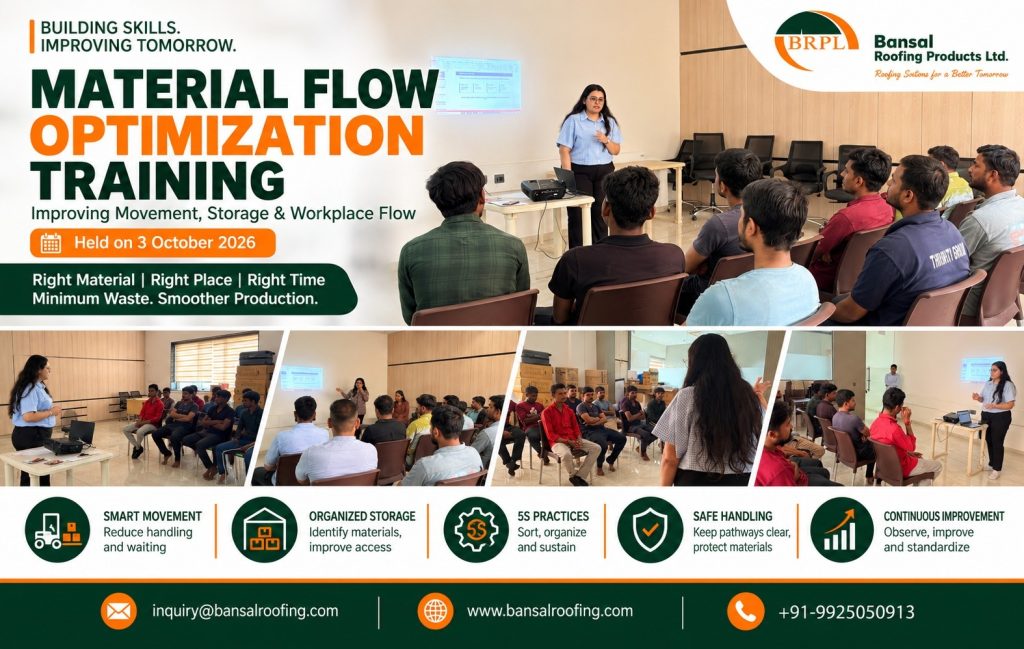
Improving Material Movement, Storage & Workplace Flow
“Right Material – Right Place – Right Time – Minimum Waste.”
Introduction
Bansal Roofing Products Ltd. (BRPL) conducted a practical training session on “Material Flow Optimization” to build employee awareness about efficient material movement, storage, handling and workplace organization.
Material Flow Optimization focuses on ensuring that the right material reaches the right place at the right time with minimum waste. The training highlighted how improved material flow can support productivity, safety, quality and smooth production operations.
Understanding Material Flow Optimization
Material flow is not simply about moving materials faster. It is about removing unnecessary movement, reducing waiting and repeated handling, improving storage practices and making material availability more predictable.
Receiving → Inspection → Storage → Staging → Production → Inspection → Finished Goods → Dispatch
Key Topics Covered During the Training
- Improving material storage and identification
- Reducing waiting and handling time
- Maintaining clear material movement pathways
- Improving workplace layout and accessibility
- Organizing Work-in-Progress (WIP)
- Improving communication between Stores and Production
- Supporting safe material handling
- Applying 5S for better workplace organization
- Standardizing improved material-flow practices
Identifying Material-Flow Wastes
Employees were introduced to common material-flow wastes, including unnecessary transportation, waiting, excess inventory, unnecessary handling, poor storage, unnecessary motion, damage and errors.
A key question discussed during the session was: “Why is this material being moved again?” Identifying the reason behind each movement can help teams discover unnecessary activities and develop better working methods.
5S and Better Material Organization
- Sort – Remove unnecessary materials and items.
- Set in Order – Arrange required materials systematically.
- Shine – Keep storage and work areas clean.
- Standardize – Establish consistent storage and replenishment practices.
- Sustain – Maintain the improved system through regular checks.
Practical Problem-Solving Approach
The training introduced a structured improvement approach: Identify → Observe → Measure → Analyse → Improve → Check → Standardize → Continue.
Employees were encouraged to observe actual workplace conditions, understand root causes, implement practical improvements and measure the results. The PDCA approach (Plan, Do, Check, Act) and 5 Why Analysis were also discussed as useful tools for continuous improvement.
Employee Participation
Material-flow improvement is most effective when employees who work directly with materials and production processes participate in identifying problems and suggesting improvements.
- Report material-flow problems and unnecessary handling
- Suggest better storage and movement arrangements
- Highlight congestion and safety concerns
- Support improvement trials and monitor results
- Help maintain the improved standard
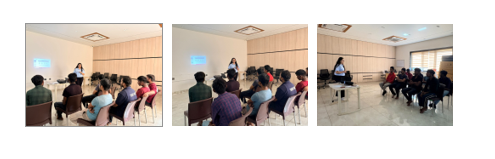
Training Session at BRPL
The session provided an interactive environment where employees participated in discussions and gained practical understanding of material-flow improvement. The discussion connected material movement, workplace organization, safety, storage, productivity and continuous improvement with day-to-day manufacturing activities.
Expected Benefits for BRPL
- Better material visibility and organized storage
- Reduced unnecessary movement, handling and waiting
- Improved production support and communication
- Better workplace safety and use of space
- Reduced material damage and errors
- Greater employee involvement in improvement activities
Continuous Improvement at BRPL
Material-flow improvement can be applied across BRPL’s manufacturing environment, including PEBs, purlins, deck sheets, roofing sheets, perforated sheets and insulated sheets. Improvements should be based on actual workplace observations and operational requirements.
Material Flow Optimization is not a one-time activity. Continuous observation, measurement, standardization and employee involvement are essential to sustain improvements over time.
Conclusion
The Material Flow Optimization Training at Bansal Roofing Products Ltd. reinforced the importance of efficient material movement, organized storage, safe handling and continuous improvement. By focusing on “Right Material – Right Place – Right Time – Minimum Waste,” employees can contribute to smoother production processes, improved workplace organization, better safety and higher operational efficiency.
“Observe the Flow. Find the Waste. Improve the Movement. Standardize the Result.”